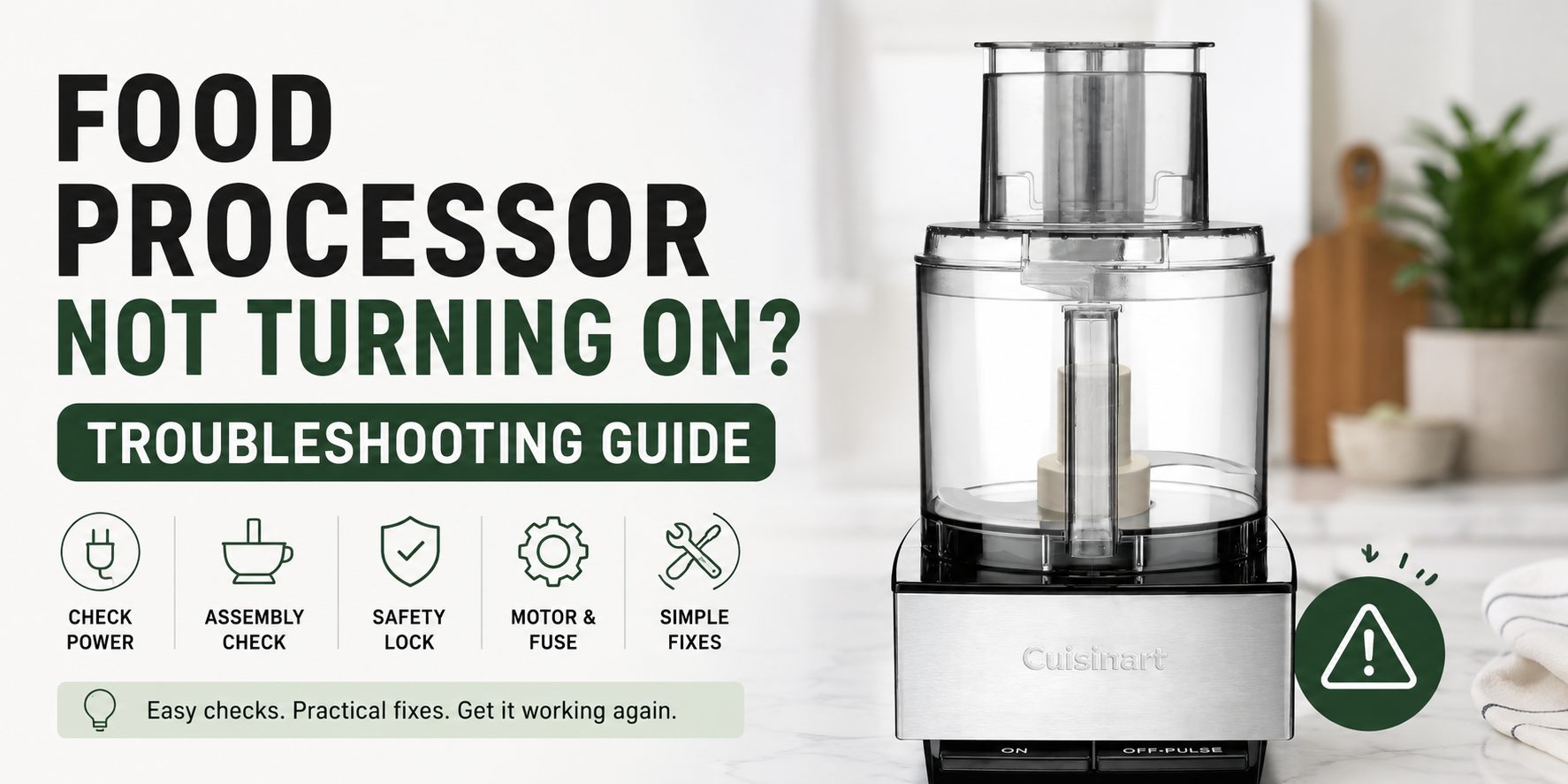
Food Processor Not Turning On? Troubleshooting Guide
You press the button, and nothing happens. Before you assume your food processor is dead, know this: most “won’t turn on” issues come down to a safety interlock that isn’t fully engaged, not a broken motor. It’s one of the most common — and most fixable — small appliance complaints out there.
Here’s how to diagnose the problem step by step, and which models are worth considering if yours really has reached the end of its life.
| Product | Best For | Notes |
|---|---|---|
| Cuisinart 14-Cup Food Processor | Most Trusted All-Around | Reliable safety-lock switch design |
| KitchenAid 13-Cup Food Processor | Powerful Motor | Sturdy bowl-lock mechanism |
| Hamilton Beach 10-Cup Food Processor | Best Budget Pick | Simple design, fewer failure points |
| Ninja Professional Plus Food Processor | Best Mid-Range | Versatile motor base |
| Breville Paradice 16-Cup Food Processor | Best Premium Pick | Robust electronic safety interlock |
Individual Product Reviews
Cuisinart 14-Cup Food Processor
Overview: Cuisinart is one of the most established names in food processors, and this 14-cup model is known for a dependable safety-lock switch — one of the most common points of failure in other brands.
Pros:
- Well-known, dependable safety-lock design
- Large 14-cup capacity for bigger batches
- Wide availability of replacement parts and accessories
Cons:
- Larger footprint, needs storage space
- Base can be heavy to move for smaller kitchens
Best For: Households replacing an older unit that failed due to a worn or misaligned lock switch.
Verdict: A dependable, no-surprises upgrade if reliability is your top priority.
KitchenAid 13-Cup Food Processor
Overview: KitchenAid’s food processor pairs a powerful motor with a sturdy bowl-lock mechanism, reducing the chance of the loose-fit issues that often cause units to stop responding.
Pros:
- Strong, consistent motor performance
- Sturdy bowl and lid locking mechanism
- Dishwasher-safe parts for easy cleanup
Cons:
- Higher price point than entry-level models
- Some users find the lid latch stiff at first
Best For: Home cooks who process tougher ingredients regularly and want a motor built to match.
Verdict: A strong choice if your old unit’s motor simply gave out under regular heavy use.
Hamilton Beach 10-Cup Food Processor
Overview: With a simpler mechanical design and fewer components, the Hamilton Beach 10-Cup model has fewer potential points of failure — a practical, budget-friendly replacement.
Pros:
- Affordable price point
- Simple design with fewer moving parts to fail
- Compact size fits smaller kitchens
Cons:
- Smaller capacity than premium models
- Motor is less powerful for dense or tough ingredients
Best For: Budget-conscious buyers who mainly need light chopping and prep tasks.
Verdict: A solid, low-cost replacement if your needs are basic and you want to minimize future issues.
Ninja Professional Plus Food Processor
Overview: The Ninja Professional Plus offers a versatile motor base with multiple speed settings, making it a solid mid-range replacement for a wide range of food prep tasks.
Pros:
- Versatile motor base with multiple functions
- Sturdy, well-reviewed locking mechanism
- Competitive pricing for the feature set
Cons:
- Louder than some competitors during operation
- Bowl can be bulky to clean in tight spaces
Best For: Home cooks who want strong all-around performance without paying premium prices.
Verdict: A dependable middle-ground option that balances price, power, and durability.
Breville Paradice 16-Cup Food Processor
Overview: Breville’s Paradice line uses a more robust electronic safety interlock than many competitors, directly addressing one of the most common causes of a food processor that won’t power on.
Pros:
- Advanced electronic safety interlock reduces false “won’t start” issues
- Large 16-cup capacity for bigger households
- Premium build quality and finish
Cons:
- Highest price point on this list
- Larger unit requires more counter and storage space
Best For: Buyers who want to avoid a repeat of the same “won’t turn on” issue and don’t mind paying more for it.
Verdict: If lock-switch failures are the reason you’re shopping, this is the most deliberately engineered fix.
| Feature | Cuisinart 14-Cup | KitchenAid 13-Cup | Hamilton Beach 10-Cup | Ninja Pro Plus | Breville Paradice 16-Cup |
|---|---|---|---|---|---|
| Capacity | 14 cups | 13 cups | 10 cups | Varies by bowl | 16 cups |
| Safety Lock Type | Mechanical | Mechanical | Mechanical | Mechanical | Electronic interlock |
| Price Tier | Mid-range | Mid-to-high | Budget | Mid-range | Premium |
| Best For | Reliability | Power | Budget/basic prep | All-around balance | Avoiding recurring lock issues |
Buying Guide: Why Your Food Processor Won’t Turn On
Most food processors are built with a safety interlock system that prevents the motor from running unless the bowl and lid are locked into place correctly. This protects you from injury — but it’s also the most common reason a perfectly good machine seems “dead.” Work through these checks in order.
1. Bowl Not Fully Seated The bowl needs to sit flush on the base and often needs a slight twist to lock in. If it’s even slightly off-angle, the safety switch won’t engage and the unit won’t power on.
2. Lid Not Locked Correctly Most models require the lid to click or twist into a specific locked position. A lid that looks closed but isn’t fully locked will stop the machine from starting.
3. Feed Tube or Pusher Missing Some processors also require the feed tube pusher to be in place before the safety circuit completes. Check your manual for whether this applies to your model.
4. Outlet or Power Cord Issues Before assuming it’s the appliance, test the outlet with another device, and check the cord for visible damage or a loose connection at the base.
5. Overheating Shutoff If you’ve been running the processor hard for an extended task, some models have a thermal cutoff that temporarily disables the motor to prevent damage. Unplug it and let it cool for 15–20 minutes before trying again.
6. Worn or Failing Safety Switch If everything is aligned correctly and it still won’t start, the interlock switch itself may have worn out or failed — this is a common issue in older units and usually isn’t cost-effective to repair.
7. Motor Failure If the switch tests fine (or you’ve bypassed it briefly to check, which we don’t recommend without professional help) and there’s still no response, the motor itself may have failed. At this point, replacement makes more sense than repair.
FAQs
Q: Why won’t my food processor turn on even though it’s plugged in? A: The most common cause is the bowl or lid not being fully locked into place, which prevents the internal safety switch from completing the circuit.
Q: Is it safe to bypass the safety lock myself? A: No. Bypassing the safety interlock removes an important protection against injury from moving blades and isn’t something we’d recommend attempting.
Q: How do I know if it’s the safety switch or the motor that’s broken? A: If the bowl and lid are properly locked and the outlet works, but the unit still won’t start, it’s often the switch. A qualified appliance repair technician can test this safely if you want to confirm before replacing the unit.
Q: Can overheating actually shut off a food processor? A: Yes, many models include a thermal cutoff that temporarily disables the motor after extended heavy use to prevent damage. It usually resets after the unit cools.
Q: Is it worth repairing an old food processor, or should I replace it? A: For most consumer-grade models, repair costs (parts plus labor) often approach or exceed the cost of a new mid-range unit, making replacement more practical in many cases.
Q: How can I prevent this problem in a new food processor? A: Look for models with a clearly marked, easy-to-align locking mechanism, and always make sure the bowl and lid are fully seated before pressing the power button.
Final Verdict
If your food processor won’t turn on and the basic checks didn’t solve it, the Cuisinart 14-Cup Food Processor is our top pick for dependable, no-surprises replacement. For more processing power, the KitchenAid 13-Cup Food Processor is a strong option, while the Hamilton Beach 10-Cup Food Processor is the most budget-friendly choice.
If you want an all-around balance of price and performance, the Ninja Professional Plus Food Processor is a great middle-ground pick. And if avoiding a repeat of the same lock-switch issue is your top priority, the Breville Paradice 16-Cup Food Processor offers the most robust electronic safety interlock of the group.
Related Articles
- Why Is My Coffee Maker Not Brewing Hot Enough? (Common Causes & Fixes)
- Why Does My Coffee Taste Bitter Even With a Good Machine?
- 10 Kitchen Gadgets That Save Time
- Kitchen Cleaning Hacks
- Best Food Storage Containers